

CNC milling is a subtractive manufacturing procedure where a computer-controlled rotating tool removes material from a solid block to form a custom part. In India, this high-precision technology is the spine of the automotive, aerospace, and electronics industries, making sure of smooth repeatability with tolerances generally hitting ±0.01mm.
The manufacturing industry in India is experiencing a huge transformation. Driven by national initiatives like Make in India and an international shift toward resilient supply chains, factories across the nation are upgrading from old-school workshop ways to extremely automated systems. At the crucial center of this industrial revolution is CNC milling.
Table of Contents
Whether it is an engine part of a vehicle, a titanium element for a fighter jet, or a custom mold for a medical gadget, computer-controlled manufacturing makes sure that everything is formed with high precision. Here, we will discuss the fundamentals of understanding CNC milling in India, how it varies from conventional methods, the various kinds of elements produced, and how leading manufacturers are shaping the market.



What is CNC Milling?
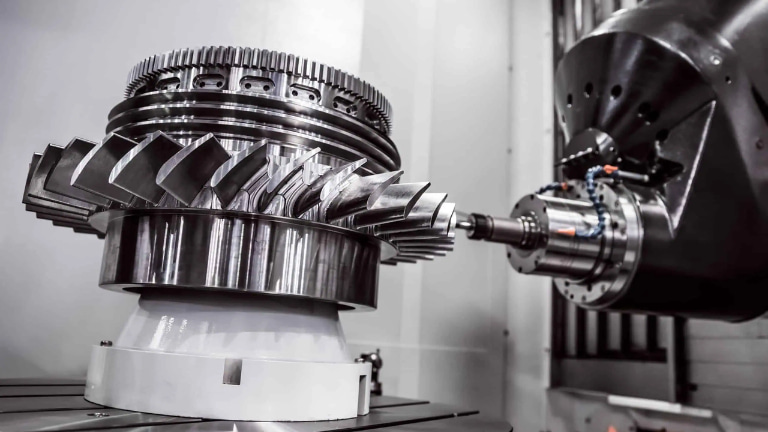
To comprehend CNC milling, it assists in breaking down the name itself. CNC stands for computer numerical control.
CNC milling is a manufacturing procedure that utilizes a computerized system to control a quickly rotating cutting tool. The machine takes a raw block of material and cuts off layers, little by bit, to carve out an extremely accurate final shape.
Rather than a human operator turning wheels and levers by hand, a technical design file is converted into a collection of numeric codes. The CNC machines read these codes and move the cutting tools along several axes with cub-millimeter precision.
CNC Machines vs. Conventional Machines – The Industrial Shift
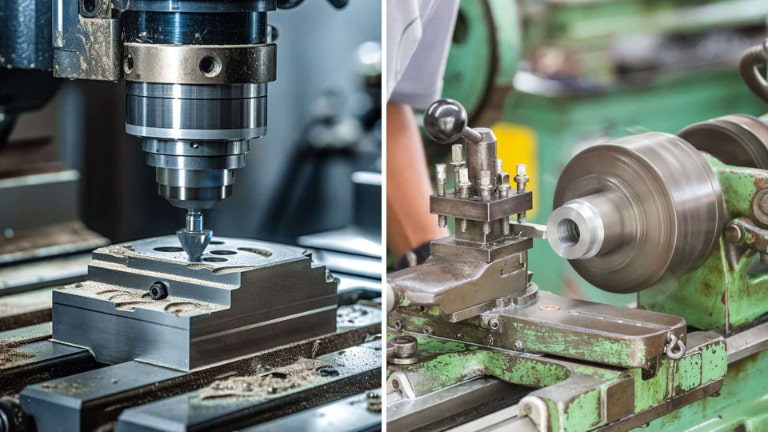
For decades, Indian machine shops depended on conventional machines. While these heritage tools made the base of early Indian industry, the advanced manufacturing landscape needs speed, complication, and uniformity that human hands just can’t match.
Here is an easy look at how these two generations of machinery compare –
| Feature | Conventional Machines | CNC Machines |
| Operation | Hand-operated by a skilled machinist turning dials. | Automated by computer software programs. |
| Consistency | Human error can cause slight variations between parts. | Every single part is an exact replica of the first. |
| Complexity | Extremely difficult to cut intricate or curved shapes. | Easily carves complex, multi-axis geometries. |
| Production Speed | Slower; requires stopping to adjust tools and measure. | High-speed, continuous operation with automatic tool changers. |
| Material Waste | Higher chance of scrap due to manual errors. | Optimized tool paths significantly minimize material waste. |
While conventional tools are still effective for fast, single repairs or common training in small workshops, any business seeking to scale up production should invest in contemporary CNC machining services.
CNC Milling Components vs. CNC Turned Components
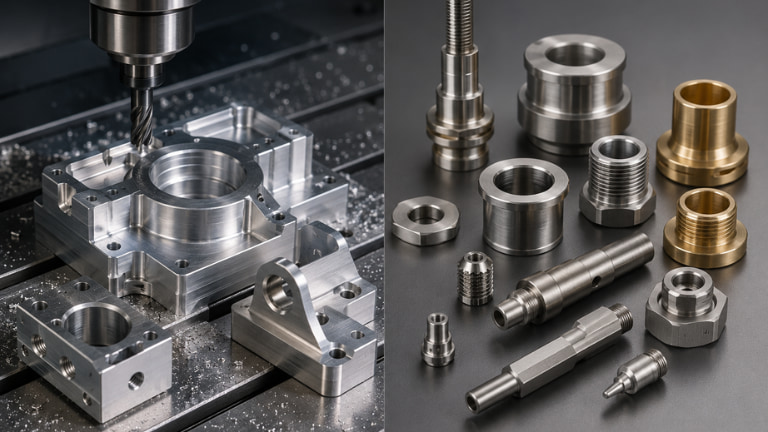
When browsing precision manufacturing catalogs, you will frequently come across two main classes of custom components – CNC milling components and CNC turned components. While both use computer control, they utilize opposite mechanical actions to structure the raw material.
1. CNC Milling Components – In a CNC milling machine, the raw metal block remains protectively clamped to the machine bed while the cutting tool rotates at high speeds. The tool moves across various directions to cut pockets, slots, holes, and complicated contours.
- Common Examples – Bracket mounts, engine blocks, custom machinery molds, electronic enclosures, and aerospace structural structures.
- Best Used For – Asymmetrical, square, rectangular, or extremely irregular structures with remarkable surface features.
2. CNC Turned Components – In a CNC turning machine, the procedure is flipped. The raw material is clamped into a chuck and spins at high speeds, while a stationary cutting tool is pressed against it to shave away material.
- Common Examples – Shafts, bolts, screws, pins, nozzles, and cylindrical pipes.
- Best Used For – Ideally symmetrical, round, or cylindrical components.
Several modern production facilities merge both ways, utilizing multi-tasking mill-turn centers to manage complicated components in a single formation.
The Role of a Leading CNC Components Manufacturer – A Look at Global Precision
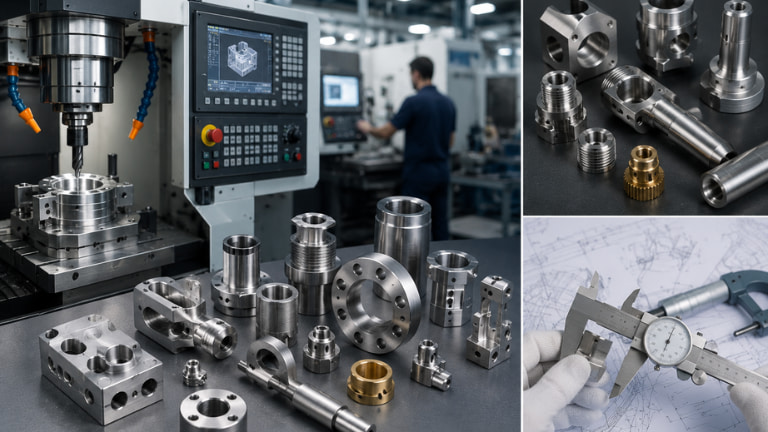
To see how these concepts run in the real world, look at Global Precision Pvt Ltd, an ISO 9001:2015 certified company. As a leading CNC component manufacturer, Global Precision has expertise in generating high-tolerance components for industries where there is zero chances for mistakes, including aerospace, defense, medical devices, and automotive engineering.
Advanced Production Capabilities – The facility at Global Precision presents how advanced precision parts manufacturing works –
1. Vertical Machining Centers – Global Precision Pvt Ltd uses high-end Hurco Vertical Machining Centers. These machines manage huge workpiece envelopes up to 1600mm to 800mm.
2. 4th Axis Machining – By adding a 4th rotary axis to their VMCs, their machines can rotate the workpiece during the cutting procedure. This permits them to cut complicated angles and structures without having to prevent and manually repositions the part.
3. Advanced CAD/CAM Software – All tool paths and programs are produced utilizing refined solid CAM software, which speeds up prototyping and decreases processing mistakes.
4. High-grade Materials – They successfully machine difficult-to-handle materials, ranging from lightweight aluminum and structural stainless steel to difficult tool steels and high-strength titanium.
Why Indian Industries Rely on CNC Machining Services
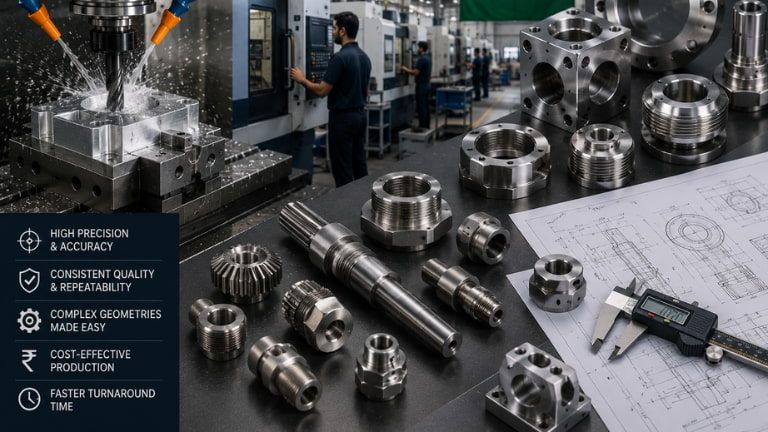
The need for localized CNC machined components manufacturers has skyrocketed across a number of major Indian industries –
1. Aerospace & Defense – Elements utilized in aircraft and radar tools demand tight tolerances. CNC milling makes sure structural components can manage extreme environmental stress.
2. Medical Technology – From titanium bone implants to surgical tool elements, medical manufacturing needs ideally seamless surface finishes and biocompatible material managing.
3. Automotive Supply Chains – India is one of the biggest automotive markets internationally. Tier-1 and OEM vendors depend on quick CNC milling to produce high-volume engine components, transmission casings, and custom dashboard molds.
4. Electronics & Enclosures – As local electronics manufacturing grows, CNC milling is utilized to carve out intricate heat sinks, aluminum housing units, and custom connector bodies.
Choosing the Right Precision Manufacturing Partner
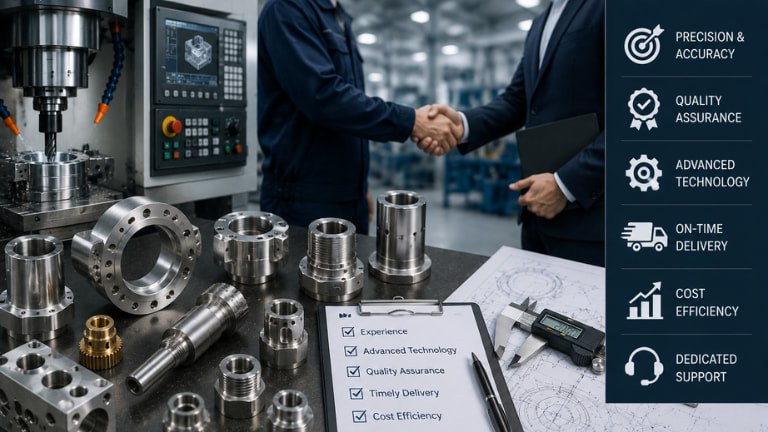
Not all machine shops are constructed the same way. If you’re a procurement manager or a business person seeking leading CNC milling manufacturers in India, keep these three selection measures in mind.
1. Rigorous Quality Controls – Make sure the shop utilizes dedicated verification tools like 3D Coordinate Measuring Machines to test part dimensions against the original blueprint designs.
2. End-To-End Prototyping – An amazing partner can take a rough drawing or a 3D model, assist in optimizing it for manufacturing, create a quick prototype, and then smoothly scale up to high-volume commercial production.
3. Traceability and Certification – Industries like protection and automotive demand clear material test certificates and ISO compliance to prove the raw metals utilized are genuine and structurally sound.
Conclusion
Understanding CNC milling in India is crucial for anybody involved in advanced supply chains, product design, or industrial expansion. By shifting away from unpredictable conventional machines and embracing automated CNC machines, Indian factories are gaining international norms of effectiveness and accuracy. Well-established companies like Global Precision Pvt Ltd show that with modern 4-axis machinery, robust digital design support, and stringent quality control, local manufacturers can successfully support crucial international applications. As the manufacturing ecosystem grows, precision CNC milling will continue to be the spine driving India’s industrial future.