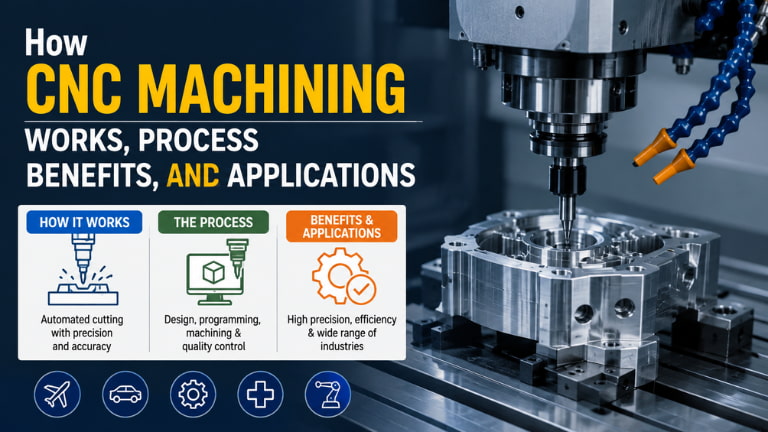

CNC (Computer Numerical Control) is an automated machining process in which computer software controls specialized tools to cut, drill, and shape materials such as metal or plastic. Used in aerospace, automotive, and other industries, these machines provide precision cutting based on digital 3D designs.
CNC machining is one of the most advanced and reliable methods of production used across industries, such as aerospace, automotive, electronics, and medical. The process is automated and controlled through computer software, featuring specialized tools that shape materials into highly complex components. The machining process can efficiently produce CNC turned components, milled parts, custom prototypes, and other precision-engineered parts, allowing manufacturers to achieve consistent results while reducing errors.
Table of Contents
Therefore, before investing in CNC machining services, businesses must understand how CNC machining works, types, factors that affect CNC machining price, and how they can choose reliable manufacturers.



What is CNC Machining?
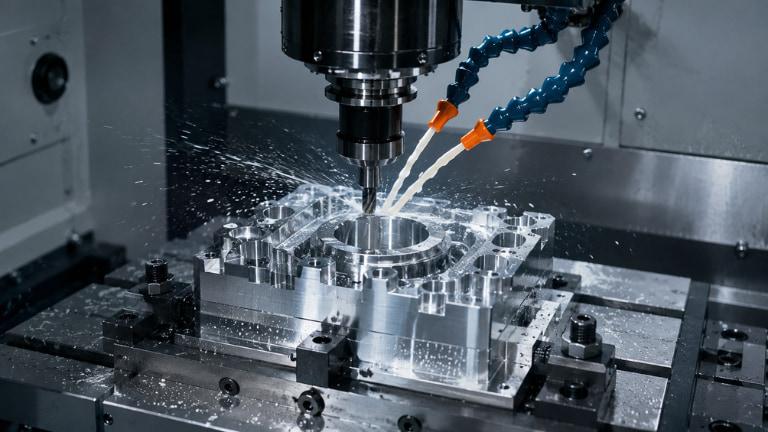
CNC machining is an automated process controlled by pre-programmed computer software that directs specialized tools to machine metals, plastics, wood, and composites into complex shapes.
Due to its cut quality, speed, and precision, CNC machining is widely used as a subtractive manufacturing process in various industrial sectors, including aerospace, automotive, electronics, medical, woodworking, and furniture.
Types of CNC Machining Processes:
- CNC Milling
- CNC Turning
- CNC Drilling
- CNC Grinding
- CNC Laser Cutting
- CNC Plasma Cutting
- CNC Electrical Discharge Machining (EDM)
- CNC Waterjet Cutting
CNC Machined Components: Difference Between Turning and Milling Parts
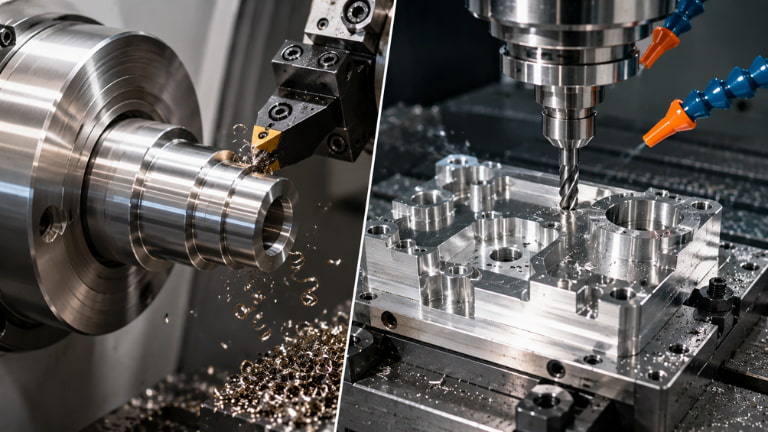
Here is a brief comparison between CNC Turned Components and CNC Milling Components:
| Feature | CNC Turned Components | CNC Milling Components |
| Process | Made on a CNC lathe by rotating the workpiece. | Made on a CNC mill using rotating cutting tools. |
| Best For | Round and cylindrical parts. | Complex shapes and flat surfaces. |
| Examples | Shafts, pins, bushings, bolts. | Brackets, housings, plates, gears. |
| Operations | Turning, threading, drilling, facing. | Milling, drilling, slotting, contouring. |
| Advantage | Fast and accurate for cylindrical parts. | Creates complex and precise designs. |
How Does CNC Machining Work?
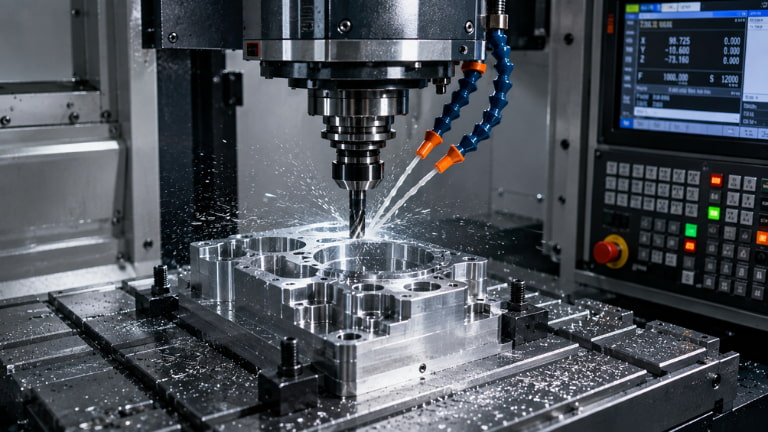
The CNC machining process is divided into various stages, from building a 2D or 3D design to final execution. Stages that are involved in the process include CAD designing, CAM and code conversion, machine setup, and execution.
Below is a complete process of how CNC machining works:
1. Computer-Aided Design (CAD)
At the first stage, the engineers who handle the CNC machine use CAD (Computer-Aided Design) software to create precise 2D or 3D blueprints of the final product or component.
The blueprint they design consists of precise geometries, tight tolerances, dimensions, and surface characteristics.
Popular CAD software used in CNC machining:
- Fusion: An all-rounder 3D design and toolpath tool
- SolidWorks: Used for advanced-level solid modeling of mechanical parts
- Onshape: A cloud-based parametric CAD system
- AutoCAD: Best for 2D drafting and basic 3D modeling
- FreeCAD: An open-source parametric CAD system modeler
Common File Formats:
- STEP (.stp / .step): For precise 3D geometry and smooth curvatures
- IGES (.igs): Mainly used for surface models
- DXF / DWG: A standard format for 2D flat profiles and drawings
- STL (.stl): Commonly chosen for mesh-based and complex artistic shapes
2. Code Generation (CAM Programming)
Programmers transfer the CAD file into the CAM (Computer-Aided Manufacturing) software. They then select the right cutting tools, define toolpaths, and assign required parameters, such as spindle speed (RPM) and feed rates.
The CAM software then converts these instructions into G-code to determine the physical coordinates and movements and M-code, which is responsible for ancillary functions like coolant flow and spindle operation.
3. Machine Setup and Zero Point Calibration
For this step, the controller secures the workpiece tightly on the CNC machine by using workholding tools such as a vise or clamps. Then, a zero point (origin coordinate) is established so the machine ensures the digital toolpath aligns perfectly with the workpiece.
4. Program Execution and Material Removal
The G-code program is uploaded to the main controller of the CNC machine. A dry run is also performed to verify path safety and prevent costly crashes. Then, the operator initiates the program, instructing the machine to start:
- Milling: Rotation of multi-point tools to remove the excessive material.
- Turning: A cylindrical workpiece spinning while a stationary tool trims the profile.
- Drilling: Plunging bits to create precise cylindrical holes.
5. Inspection and Finishing
Once the component is finished, it is removed and measured against the original specifications using quality control tools. Then, those parts go through deburring, smoothing, or cleaning to achieve the desired surface smoothness.
What are the Benefits of CNC Machining?
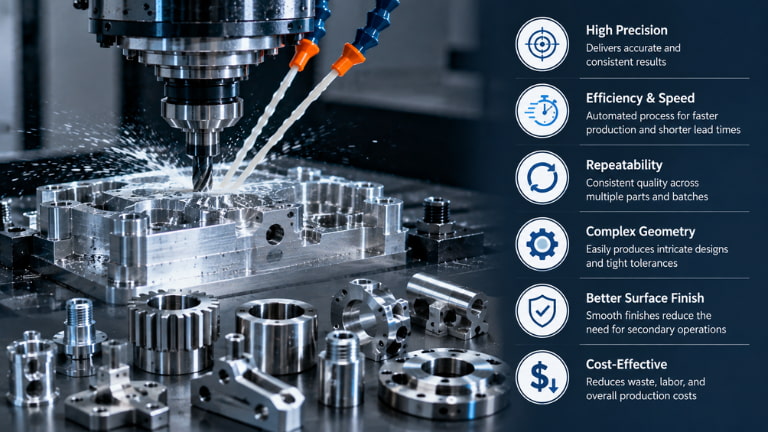
Here are the benefits of CNC machining:
- Extreme Precision and Accuracy: CNC machining operates with tolerances as tight as ±0.001 inches, ensuring high accuracy and reducing human error.
- Material Consistency: Produces accurate dimensions and finishes across production batches.
- Continuous Output: The CNC machine can run continuously with minimal operator intervention, apart from routine maintenance and tool changes.
- Complex Capabilities: CNC machines feature multi-axis systems that are capable of producing highly complex 3D geometries with high precision.
- Material Versatility: The machine can work with a wide variety of materials, including metals, plastics, wood, and composites.
- Reduced Labor Costs: By using CNC machining, manufacturers can significantly reduce costs spent on labor, as fewer operators are required compared with conventional machining.
- Lower Material Waste: The digital toolpaths are optimized to maximize material usage to reduce waste.
- Enhanced Workplace Safety: CNC machining is an automated production process, which requires no direct contact with the moving parts and a dangerous cutting environment.
What are the Applications of CNC Machining?
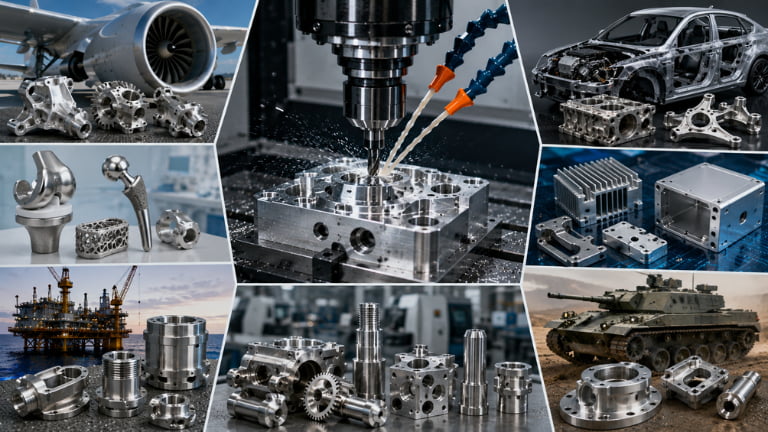
CNC machining is used across various industrial operations that need precision cutting, shaping, and drilling of materials through pre-programmed computer software.
Look at the applications of CNC machines:
| Industry | Applications of CNC Machining |
| Aerospace | Aircraft parts, engine components, brackets, and precision structural parts. |
| Automotive | Engine parts, transmission components, custom prototypes, and molds. |
| Medical | Surgical tools, implants, and medical equipment components. |
| Electronics | Housings, connectors, heat sinks, and precision enclosures. |
| Defense | Weapon components, vehicle parts, and specialized equipment. |
| Industrial Machinery | Machine parts, gears, shafts, and custom components. |
| Robotics | Robotic arms, frames, joints, and precision movement parts. |
| Energy | Turbine parts, valves, and equipment components. |
What Factors Affect the CNC Machining Price in India?
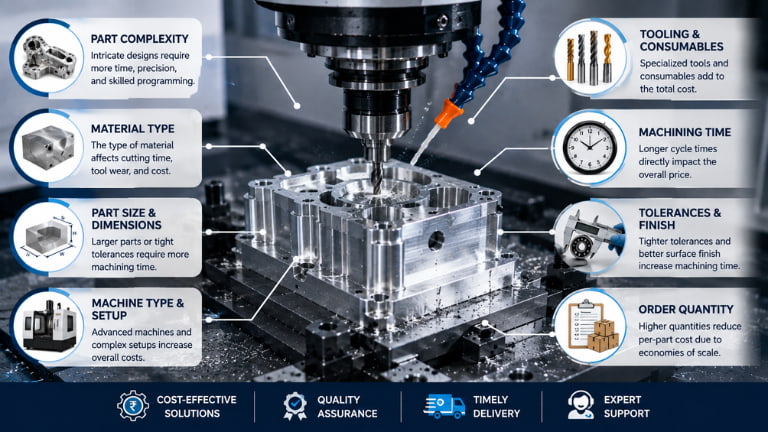
Factors that affect CNC machining in India price include:
- Material type
- Part complexity
- Machine type
- Production volume
- Tolerance requirements
- Finishing requirements
How to Choose a CNC Machining Service Provider?
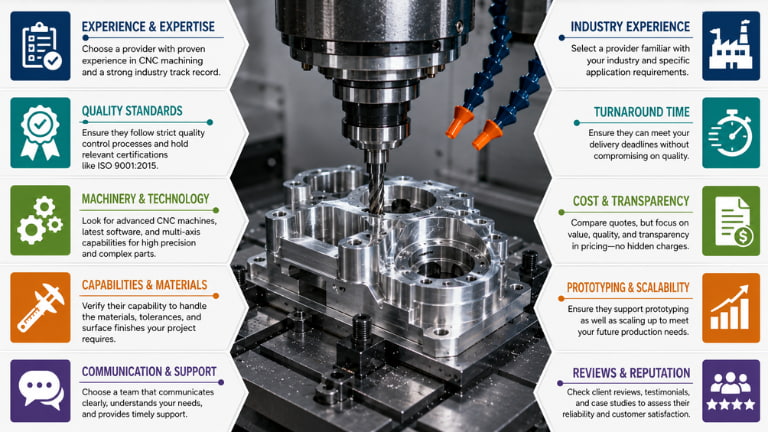
To choose a reliable CNC machining service provider, keep the following factors in mind:
- Machine Variety: Check if the CNC machining service provider operates 3-axis, 4-axis, or 5-axis, depending on the required geometries and dimensions.
- Material Range: Make sure that the CNC components manufacturer operates with a wide range of materials, such as specific metals, engineering plastics, or composites.
- Tolerances: Ensure that the equipment is capable of meeting tight dimensional requirements, without losing consistency.
- Inspection Tools: Check for mandatory inspection tools such as coordinate measuring machines (CMM) and digital inspection technology.
- Quality Standards: Industrial quality standards such as ISO 9001 must be provided by the manufacturer to minimize the risks of build quality and structural integrity.
- Traceability: Reliable CNC machined components manufacturers also provide information on how they handle in-process monitoring and material traceability.
Conclusion
CNC machining is a subtractive manufacturing process that allows manufacturers to produce precise, complex, and consistent components across various industries. CNC turning, milling, and advanced multi-axis machining are examples of how this technology helps manufacturers increase productivity while reducing waste. Therefore, understanding the process, benefits, applications, and primary selection factors helps businesses choose a reliable CNC machining service provider.
If you are looking for precision CNC machining services, you can reach out to us. We are Global Precision Pvt Ltd, a certified high-precision machining and manufacturing company in India. We provide specialized services, such as CNC turning and 4-axis VMC milling, ensuring the end product meets your specific requirements. So, contact us today to get highly trusted CNC machining services in India.
Also Read : Exploring High Precision Components and Machining in India
Frequently Asked Questions:
1. How do I choose the best CNC machine company in India?
To choose the best CNC machine company in India, consider evaluating:
- Machining Capabilities
- Certifications
- Quality Standards
- Delivery Timelines
- After-Sales Support
2. What services are offered by a CNC machining service provider?
A CNC machining service provider offers CNC turning, milling, drilling, grinding, prototyping, and custom component manufacturing.
3. What factors affect the CNC machining price?
The factors that affect the CNC machining price include:
- Material type
- Part complexity
- Machine type
- Production volume
- Tolerance requirements
- Finishing requirements
4. What materials can be used for CNC machining?
Materials that can be used in CNC machining include:
- Aluminum
- Steel
- Stainless Steel
- Brass
- Titanium
- Plastics
- Wood
- Composites
5. What materials are used in metal CNC machining in India?
Types of metals that are used in metal CNC machining in India include:
- Aluminum Alloys
- Steel and Stainless Steel
- Non-Ferrous Metals