
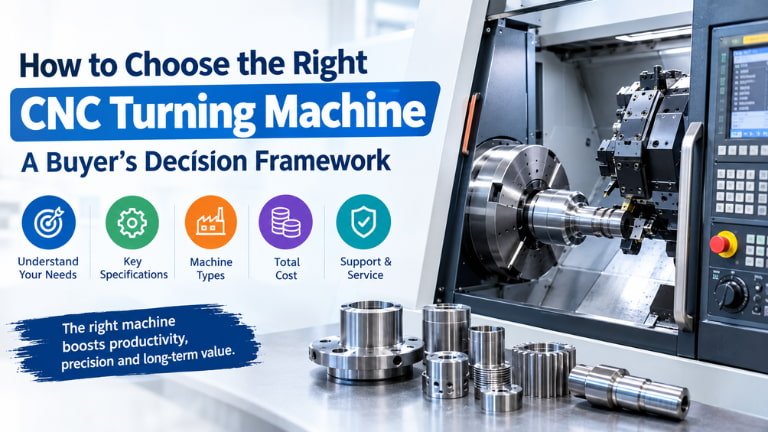

To choose the right CNC turning machine, match its features with your production needs. Check the spindle power, machine strength, material, part size, production volume, and required accuracy. This helps you choose a machine that works well for your manufacturing needs.
Choosing the right machine is a bit like choosing the right tool for a job. You would not use a small screwdriver to fix a big machine, right? The same idea applies to manufacturing. A CNC turning machine needs to match the work you want it to do.
Table of Contents
Different CNC machines have different sizes, speeds, features, and working abilities. So, the best machine for you depends on the parts you want to make, the material you use, how much you need to produce, and how accurate the parts need to be. Your budget, workspace, tools, and future production plans are also important. Therefore, checking all these things before buying helps you avoid choosing the wrong machine and spending money on something that does not suit your work.


What Is a CNC Turning Machine?
A CNC Turning machine is a computer-controlled machine that is used to shape a solid piece of material. The material rotates while a cutting tool removes small parts from its surface. This process helps make accurate and round parts in the needed shape and size.
The machine follows computer instructions, so it repeats the same cutting process without making mistakes. It is mainly used to make cylindrical or symmetrical parts for different types of machines and equipment.
Why Choosing the Right CNC Turning Machine Matters
Choosing the right machine affects the quality of your parts, production speed, and overall costs. A machine is also a long-term investment, so buying one with the wrong features may leave you paying for capabilities you do not use or struggling with work that the machine cannot handle.
- Matching the Machine With Your Production Needs: First, think about how much work you need to do. A basic machine may be enough for small or medium production and jobs that change often. Large production orders may need automation, multiple-axis movement, or other advanced features. So, buy the CNC turning machine that matches your actual workload instead of simply having more features than you need.
- Accuracy and Quality: Accuracy is important when the finished parts need to meet specific measurements. A suitable machine helps keep the size and shape of parts consistent during production. Machine rigidity, spindle quality, and thermal stability also matter when you need tighter measurements.
- Production Speed: Production speed becomes more important when you need to make a large number of parts. Some advanced machines also handle operations such as milling, drilling, and tapping in one setup. This reduces the need to move the part between different machines and helps save production time.
- Operating and Maintenance Costs: The purchase price is not the only cost you need to consider. Electricity, installation, tools, operator training, software, repairs, and CNC turning machine maintenance also add to the total cost. That is why looking at these expenses before buying gives you a clearer idea of what the machine will cost over time.
- Long-Term Production Needs: Your production requirements may grow as your business grows. A machine that supports automation, connectivity, or automatic material feeding may be useful when production increases. That is why a CNC components manufacturer should choose a machine that remains useful for a longer time.
How to Choose the Right CNC Turning Machine
Choosing a machine becomes much easier when you first understand what you actually need to make. Think about the parts, their size, the material, the accuracy you need, and how fast you want to make them. These things help you find a machine that fits your work.
- Understand the Type of Parts You Manufacture: First, look at the parts you want to make. Some parts only need simple cutting, such as making the outside round or cutting the end. Other parts may also need drilling, milling, or tapping. So, if you make CNC turned components, choose a machine that has the right features for those parts.
- Check Material and Part Size: Next, check what material you will use and how big the parts are. Steel may need more machine power, while materials like aluminium may need higher cutting speeds. Also, check the maximum diameter and length the machine can handle.
- Consider Required Accuracy and Surface Finish: Think about how exact your parts need to be. Some parts need very precise measurements, while others have more relaxed requirements. Moreover, the machine should also give the smooth surface finish your parts need.
- Check Spindle Speed and Power: The spindle is the part that spins the material. Its speed and power affect how well the machine cuts. Softer materials may need higher speeds, while heavy cutting may need more power and stronger machine construction.
- Consider Turning Diameter and Length: Before buying, check whether the machine is big enough for your parts. Look at its maximum turning diameter and turning length. If you plan to use automatic material feeding, also check the machine’s bar capacity.
- Look at Tooling and Workholding: The machine needs the right tools to cut the material and a good way to hold the part firmly. Therefore, check the number of tools it can hold and how quickly they can be changed. Features such as a sub-spindle or collet system can also help reduce extra setups.
- Choose the Right CNC Control System: The control system is like the machine’s command center. It tells the machine what to do. So, choose one that your operators understand and that works well with the way you program your machines.
- Consider Automation Requirements: If you need to make the same parts again and again, automation may save a lot of time. Features such as bar feeders, parts catchers, and robotic loaders help reduce manual work. This becomes especially useful when production volumes are high.
For businesses that also produce CNC milling components, it is useful to consider how the machine fits into the wider production process. A machine that suits your different manufacturing needs may make daily production easier.
Other Important Factors to Check Before Buying
Technical features are not the only things to check before buying a CNC turning machine. Its size, installation needs, maintenance, service, spare parts, and total cost also matter.
- Machine Size and Available Floor Space: Check the machine size and make sure your workshop has enough space for it. Leave some room for the operator, tools, and maintenance work.
- Power and Installation Requirements: Check the machine’s power supply and installation requirements before buying. Make sure your workshop is ready for the required electrical setup and installation space.
- Ease of Operation and Maintenance: A machine that is easy to operate makes daily work simpler. It should also be easy to clean, check, and repair. Regular CNC turning machine maintenance helps keep the machine running smoothly.
- Manufacturer Support and Service: Good support is important after buying a machine. Therefore, look for a trusted manufacturer like Global Precision Pvt. Ltd. that provides installation help, training, technical support, and repair services when needed.
- Spare Parts Availability: Ask whether spare parts are easily available. If you have quick access to the right parts, it helps reduce machine downtime and keeps production moving.
- Compare Service and Support: Before making a decision, compare the support offered by different manufacturers. Check their warranty, training, technical help, and spare-parts support. This is especially useful for CNC machined components manufacturers that depend on regular machine operation.
Conclusion
Choosing the right CNC turning machine becomes easier when you check your parts, material, size, accuracy, production needs, and budget. Also, remember to check maintenance, automation, and after-sales support before buying.
For businesses that need accurate parts, Global Precision Pvt. Ltd. provides machining and manufacturing solutions for different industries. Our company offers CNC machining, precision component manufacturing, mould and die manufacturing, prototyping, and high-volume production. We also have CNC machines, vertical machining centres, testing equipment, and design facilities. These facilities help businesses get accurate components and handle different production needs in one place.