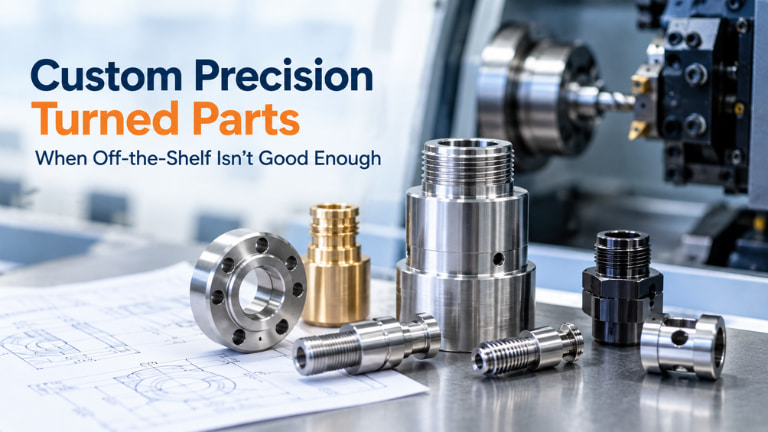

Custom precision turned parts deliver exact dimensions, tight tolerances, and specialized materials like metals, plastics, and wood. On the other hand, standard or off-the-shelf components often fall short because they don’t provide the exact fit or meet tolerance specifications.
Standard components, unlike custom precision parts, fall short in industrial applications. They cannot handle the unique loads, tight spaces, or extreme conditions that only specialized components can offer. For instance, if you force a standard bearing into a design, even if it somehow fits, it will lead to quick wear, overheating, and premature failure.
Table of Contents
Thus, no matter the applicable use or component type, choosing custom precision components is recommended. In addition, by understanding when off-the-shelf parts are not good or have limitations, you can know when you must switch to custom precision turned parts under specific requirements.



What Are Custom Precision Turned Parts?
Custom precision turned parts are custom components that are manufactured using specialized machines, using raw materials such as metals, engineering plastics, composites, and wood. In addition, to ensure accuracy and meet the strict tolerance specifications, factors such as machine, tooling, workholding, and process control are kept under strict consideration in the process.
When Off-the-Shelf Parts Fall Short
Off-the-shelf parts are specifically designed to be used in common applications with standard requirements regarding sizes and fit. But they might not be the right choice if the requirements are inclined towards specialized industrial equipment.
In addition to that, when a standard part does not match the application’s exact needs and specifications, it automatically increases the chances of premature failure, wear, and other operational failures, leading to increased maintenance costs.
Take a read on when off-the-shelf parts fall short:
1. The Fit is Not Right
Unlike precision machined components, standard parts come in fixed sizes and dimensions. So, if the component is misaligned with the fit requirements of the design, it can cause vibrations and other mechanical problems.
2. The Pressure is Too High
If a machine operates under special conditions, such as underwater drilling where the pressures are extreme, standard plastic and metal may not be able to handle these pressures, leading to melting, cracking, or corrosion.
3. Operating Conditions are Harsh
Another scenario where these standard components fail is under harsh operating conditions. They may have certain limitations in withstanding harsh conditions such as high temperatures, moisture, chemicals, or heavy friction can cause major damage to these components.
4. High Precision is Needed
Standard parts can fail to meet the tight tolerances, sizes, and accurate dimensions that certain industrial applications need to make sure operations are smooth.
5. Long Service is a Priority
Standard parts with unsuitable fitting and materials may wear quickly, increasing the need for frequent replacements. This can happen in applications where repeated cycles without misalignment are important, such as automotive engines and factory production lines.
6. The Design is Unique
Several machines used across aerospace, medical, automotive, and other industrial sectors have unique designs, far different from the standard ones. This makes standard parts incompatible for those applications where space, size, and dimensions are needed for specific performance.
Custom vs Off-the-Shelf Parts: What are the Differences
Below is a table differentiating between custom and off-the-shelf parts:
| Requirement | Off-the-Shelf Parts | Custom Precision Turned Parts |
| Dimensions | Limited to standard sizes | Made to exact dimensions |
| Tolerances | Suitable for general applications | Designed for tight tolerances |
| Material | Limited material options | Material selected for the application |
| Unique Designs | May require modifications | Manufactured to the specific design |
| Harsh Conditions | May have performance limitations | Can be designed for heat, moisture, chemicals, or wear |
| Load Requirements | Intended for standard loads | Designed around specific load conditions |
| Fit & Alignment | Standardized fit | Precise fit for mating components |
| Production Needs | Best for readily available parts | Suitable for prototypes and repeat production |
What Industrial Sectors Need Custom Precision Turned Parts?
Here are the industrial sectors that need custom precision turned parts:
| Industry | Common Applications |
| Aerospace and Defense | Aircraft systems, engines, defense equipment |
| Medical Devices and Surgical Robotics | Surgical instruments, robotic systems, medical devices |
| Automotive | Engines, transmissions, braking systems |
| Oil and Gas | Pumps, valves, drilling equipment |
| Robotics and Automation | Robotic arms, gears, motion systems |
| Industrial Machinery | Shafts, gears, machine assemblies |
| Energy and Power | Turbines, generators, valves |
| Electronics and Semiconductor | Manufacturing equipment, precision tooling, fixtures |
| Food and Pharmaceutical | Processing equipment, packaging machines, conveyors |
What to Consider Before Choosing Precision Metal Parts Fabrication Services?
Here are the things you must consider before choosing precision metal parts fabrication services:
- Material Selection
Confirm that the precision components manufacturers provides fabrication for the specific material that you are required, whether metals like stainless steel, aluminum, brass, carbon steel, composites, engineered plastics, or other materials.
- Tolerances and Precision
Ask if the manufacturer can fulfill your specific tolerance and precision requirements. As even small dimensional variations can affect the performance and consistency in production batches, confirming this with your manufacturer becomes more important.
- Fabrication Technology
Ensure asking what technology the precision machined components manufacturer use, a CNC turning, milling, Swiss machining, or multi-axis machining. This will help you achieve specific features, dimensions, and tolerances.
- Finishing and Post-Processing
Many businesses often forget about asking whether the manufacturer provides surface finishing. Post-processing processes such as anodizing, plating, passivation, heat treatment, or surface polishing ensure surface quality and protect it from corrosion.
- Manufacturer Capabilities
Before choosing a manufacturer, check their industry experience, reviews, technical expertise, calibration tools, and strict quality controls. A trusted manufacturer like Global Precision Pvt Ltd provides the best quality precision components, while also meeting specific dimensional and tolerance needs.
Conclusion
Precision components stand as a better option when off-the-shelf parts fail to meet specific requirements. They come in standard sizes, dimensions, and fits, unlike custom precision turned parts that can be designed and manufactured to meet special fit, dimensional, and performance needs. In addition, to ensure operations are smooth with reduced need for frequent maintenance, businesses must choose custom precision components from a reliable manufacturer.
If you are a business searching for professional precision manufacturing services in India, you can trust Global Precision Pvt Ltd. As an ISO 9001:2015 certified precision machined components manufacturer, we have been serving several industrial needs for years. We offer advanced CNC turning, CNC milling, and 4-axis VMC machining solutions, ensuring high precision, quality, and consistency. Thus, reach out to us to get your precision component machining services today.