
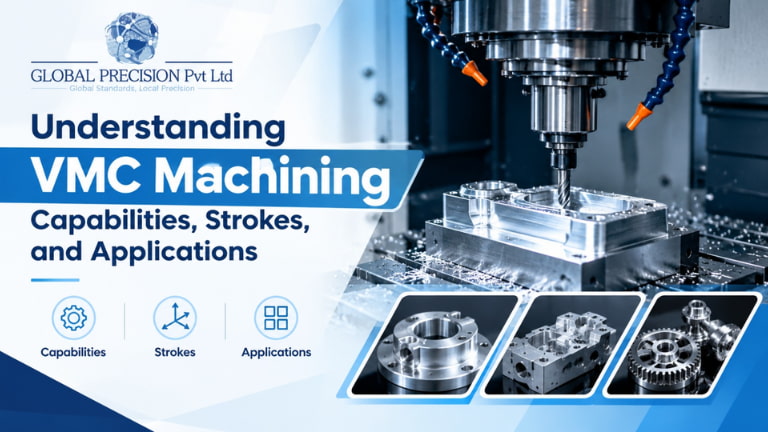

A VMC (Vertical Machining Center) is a computer-controlled milling machine used to cut, drill, and shape different materials accurately. It has a vertical spindle, while the workpiece moves along the X and Y axes, and the spindle moves along the Z-axis during machining.
Modern manufacturing needs machines that can produce accurate parts quickly and consistently. VMC machines have become an important part of this process because they can perform different cutting and shaping operations with high precision. Understanding VMC Machining helps explain how these machines work, what their strokes and capabilities mean, and where they are commonly used. These factors also help manufacturers choose the right VMC for different machining requirements.
Table of Contents
What Is VMC Machining?
VMC machining is a manufacturing process used to turn raw metal or plastic blocks into precise parts. It uses a vertical spindle that holds and rotates cutting tools over a fixed workpiece. The tool moves along three main axes, X, Y, and Z, to cut and shape the material according to the required design.



How Does a VMC Machine Work?
A VMC machine is a big machine that cuts metal and other materials. It works like a smart cutting machine. A computer tells the machine what to do and where to cut.
1. Workpiece Setup
First, the material is put on the machine table. It is held tightly with clamps so it does not move. This is important because the machine needs the material to stay in the same place while cutting.
2. CNC-Controlled Cutting
Next, the computer tells the cutting tool how to move. The tool spins and cuts the material little by little. Moreover, the tool can move in three main ways. The X-axis moves it left and right. The Y-axis moves it forward and backward. The Z-axis moves it up and down, which helps the material take the right shape.
3. Automatic Tool Changing
Sometimes, the machine needs different tools to do different jobs. One tool may cut the material, while another may make holes. The machine can change these tools by itself. This saves time for VMC machined components manufacturer and makes the work easier.
Key Capabilities of VMC Machining
A VMC machine can perform many different operations on the same component. This makes it useful for making accurate parts without moving the workpiece between several machines.
- Milling and Face Milling: These operations remove material from the surface to create the required shape or a smooth, flat surface.
- Drilling: The machine makes accurate holes in the workpiece according to the required size and position.
- Tapping: This creates threads inside a hole so that screws or bolts can fit properly.
- Boring: This makes an existing hole wider and more accurate when a specific hole size is required.
- Pocketing and Slotting: The cutting tool removes material from selected areas to create pockets or slots in the component.
- Profiling and Contour Machining: The tool follows the required outline to create curved, angled, or other detailed shapes.
A VMC machined components manufacturer can use these operations to produce different types of parts with consistent accuracy. Since several operations can be completed on one machine, there is less need to move the workpiece from one machine to another.
For businesses looking for 4 Axis VMC Job Work, an additional axis can also allow the machine to work on more sides or angles of a component. This is useful for parts that need more complex machining.
Understanding VMC Strokes
VMC strokes show how far the cutting tool can move in different directions. They help determine the size of the components a machine can handle.
What is a VMC Stroke?
A VMC stroke is the maximum distance the machine can move along the X, Y, and Z axes.
- X-Axis Stroke: Moves left to right.
- Y-Axis Stroke: Moves front to back.
- Z-Axis Stroke: Moves up and down.
These strokes decide the size and shape of the component a VMC can handle. For example, a 2000 × 700 × 850 mm stroke provides a larger working range for bigger components. Larger VMCs are useful for structural parts, while smaller machines are better for compact and precise components. Moreover, for complex parts, 4th axis VMC Machining provides an extra movement to work on different sides of a component.
Applications of VMC Machining
VMC machining is used across different industries to make accurate and reliable components. It is also useful for top VMC Machine job work in Delhi, where different types of parts are produced according to specific requirements.
- Aerospace and Defence: In aerospace and defence, a VMC components manufacturer can produce brackets, structural parts, tools, and other precision components. These parts need accurate dimensions and reliable quality.
- Automotive: The automotive industry uses VMC machined components for engine parts, housings, fixtures, and other components. It helps produce these parts with consistent sizes so they fit together properly.
- Industrial Equipment: For industrial equipment, 4 axis VMC job work is useful for making machine parts, plates, brackets, and custom components that may need machining from different sides.
- General Engineering and Prototyping: In general engineering and prototyping, 4th Axis VMC Machining is useful for making prototypes, small batches, and customized parts with different shapes and angles.
Conclusion
VMC machining helps make accurate parts in different shapes and sizes. It can do jobs like cutting, drilling, and making holes. Also, the VMC Machine price depends on the machine size, features, and working capacity.
The VMC Machine price in India can be different for different machines. Therefore, before buying one, businesses should check the machine’s size, features, and price. This helps them choose the right machine for their work.
If you are looking for a trusted manufacturer for your business, you can reach out to Global Precision Pvt Ltd. We provide precision machining solutions for industrial requirements. Our company focuses on producing accurate and trusted components while meeting different machining needs. Our VMC machining capabilities make us a suitable choice for businesses looking for quality precision components and full manufacturing support.