

In the quickly growing world of 2026 manufacturing, accuracy is no longer a luxury; it is a need. Whether you’re growing aerospace parts or medical devices, comprehending the mechanical heart of production is crucial. Central to this sector are two different but related procedures – CNC milling and CNC turning. While both are subtractive manufacturing ways, they run on basically different mechanical guidelines.
CNC Milling vs CNC Turning – Key Differences Explained
What is a CNC Machine?
A CNC machine is a high-tech tool that utilizes pre-programmed computer software to dictate the action of factory equipment and machinery. In 2026, these machines will become more intelligent, usually integrating AI to supervise tool wear and adjust speeds in real-time. This automation eliminates human mistakes, making sure that the first part generated is precisely the same as the thousandth.
CNC Milling – The Architect of Complexity
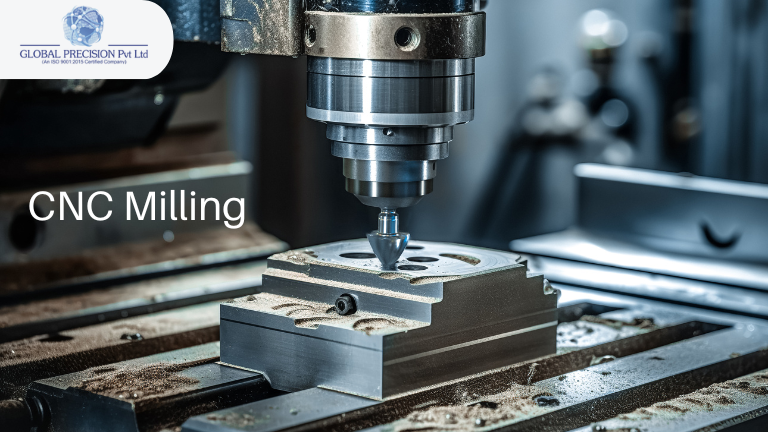
CNC milling may be the most versatile structure of machining. In this procedure, the raw material remains stationary, typically clamped firmly in a vise, while a cutting tool rotates at very high speeds to carve away the material.
How it works
The milling tool moves along several axes. Modern machines, like those utilized by Global Precision, usually feature 5-axis abilities. This permits the tool to request the part from almost any angle, making structures that would be impossible with manual tools.
Key CNC Milling Components
Because the tool can move so freely, milling is utilized to make parts with complicated, non-symmetrical geometries. General CNC milling components include –
- Engine Blocks – Complicated internal channels and accurate mounting surfaces.
- Enclosures and Brackets – Custom housings for electronics with particular slots and holes.
- Molds and Tooling – Complicated 3D shapes utilized in injection molding.
- Medical Implants – Customized orthopedic plates developed to fit particular human bone frameworks.
CNC Turning – The Master of Symmetry
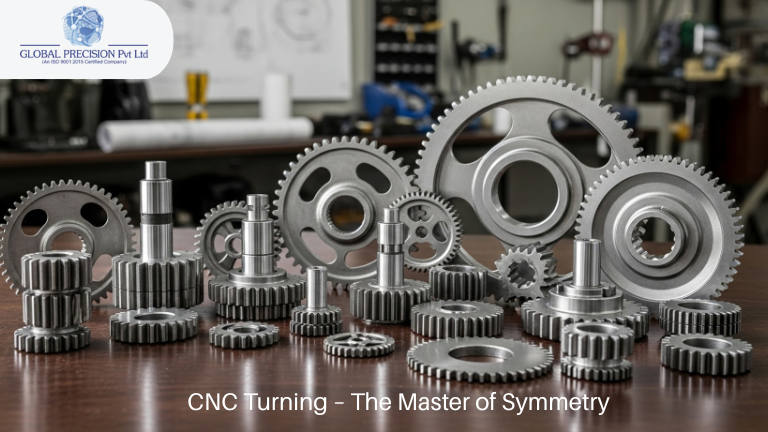
CNC turning takes the opposite systems. In this procedure, the cutting tool remains stationary, while the raw material itself is rotated at high speeds. This is performed on a machine called a lathe.
How It Works
Consider a pottery wheel. As the clay spins, the potter’s hands stay relatively still to structure the exterior. In a CNC lathe, the material spins in a chuck while a single-point cutting tool moves along the side to shave off material, making an ideally round, symmetrical structure.
Key CNC Turned Components
Turning is the most effective way to make cylindrical or conical components. Typical CNC Turned components include –
- Shafts and Axles – Crucial for any rotating machinery or automatic drivetrain.
- Fasteners – High-accuracy bolts, nuts, and screws utilized in aerospace.
- Couplings and Bushings – Seamless, round parts that permit various mechanical sections to link.
- Hollow Tubing – Custom pipes with accurate internal and external diameters.



The Role of CNC Machined Components Manufacturers
Selecting the appropriate procedure is only half the battle; the other half is selecting the respected partner. CNC machined components manufacturers are specialized factories that house these modern machines.
1. Hybrid Machining – The Power of Turn-Mill Centers
Conventionally, a part that needed both round features and flat surfaces or holes had to be moved from a lathe to a milling machine. This transfer usually introduced small alignment mistakes.
- Single-Setup Efficiency – Advanced manufacturers now use turn-mill centers. These machines feature a rotating spindle merged with live milling tools that can move along several axes.
- Extreme Accuracy – Because the part never leaves the initial clamp, the geometric connection between the turned diameters and the milled slots is ideal. This removes stack-up mistakes and makes sure that the highest possible tolerances are met.
- Reduced Lead Times – By completing a part in one hit, Global Precision can cut production time by 30-50%, permitting quicker delivery to the client.
2. Material Expertise – Navigating the Periodic Table
In 2026, CNC machined components will no longer be restricted to common metals. Manufacturers should be material polymaths to serve sectors such as aerospace, green energy, and medicine.
- Exotic Alloys – Manufacturers are now professionals in machining Superalloys such as Inconel or Monel, which are heat-resistant but notoriously tough to cut. Specialized tooling and cooling methods are utilized to control tool breakage.
- Medical-Grade Polymers – Generating CNC milling components for the medical sector usually demands working with PEEK or Ultem, plastics that are bio-compatible but demand very particular clean machining environments to sidestep contamination.
- Light weighting with Titanium – As the world moves toward electric vehicles and drones, the capability to thin-wall machine Titanium is a crucial skill, balancing extreme power with minimal weight.
3. Digital Twins & Predictive Simulation
Prior to a single chip of metal being cut, the whole procedure is born in a virtual environment. This is renowned as the Digital Twin system, and it is a hallmark of top-notch CNC machine functions.
- Virtual Prototyping – Manufacturers make a 1:1 digital replica of the machine, the tools, and the raw material. They operate the CNC program in this virtual space to check for collisions or mistakes that could harm the machine.
- Optimization of Tool Paths – AI-driven software researches the Digital Twin to locate the most effective path for the cutting tool. This decreases heat buildup and makes sure an excellent surface finish on the CNC machined components.
- Real-time Feedback Loops – In 2026, sensors on the physical machine send data back to the Digital Twin. If the machine finds a slight vibration or tool wear, the twin calculates the crucial adjustment and sends it back to the machine immediately.
4. Quality Assurance and Traceability
An advanced manufacturer’s role also comprises strict paperwork. In 2026, Global Precision and similar leaders deliver –
- Automated CMM Inspection – Coordinate Measuring Machines utilize laser probes to examine dimensions automatically, comparing the physical part against the original 3D CAD model.
- End-to-End Traceability – Every CNC turned component can be traced back to the particular batch of raw material it came from, delivering a paper trail that is crucial for safety-critical sectors such as protection and aviation.
Conclusion
For effective manufacturing, it is essential to comprehend the differences between CNC turning and CNC milling. Turning is the undisputed king of speed and symmetry for round parts, while milling is your preferred method for intricacy and detail.
You can obtain the technical know-how required to transform raw materials into high-performance CNC machined components by collaborating with seasoned CNC machined component manufacturers like Global Precision.
Also Read: Benefits of Outsourcing CNC Turned Components to Indian Suppliers