
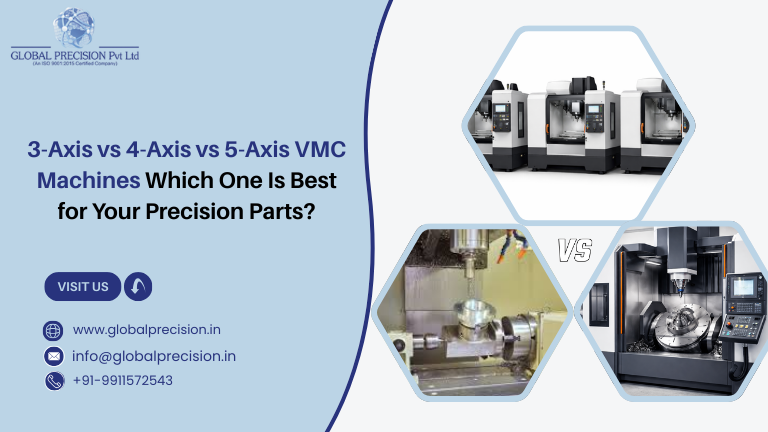
The selection of the proper VMC machines tool has a great impact on the success or failure of manufacturing projects, making equipment selection a critical aspect of manufacturing. The development of vertical machining centers (VMC) has changed the way metal and plastic components are manufactured; they have allowed for greater efficiency and faster prototyping due to improved accuracy and speed. As the designs of mechanical components continue to evolve toward more intricate structures, engineers must utilize 3-axis, four-axis, or five-axis machine tool systems.
Whether you operate as a start-up entity or as an established enterprise such as Global Precision Pvt Ltd., having an understanding of 4th Axis VMC Machining tool and other configurations is essential when providing superior quality CNC Machining.
3-Axis vs 4-Axis vs 5-Axis VMC Machines – Which One Is Best for Your Precision Parts?
What is a VMC Machine?
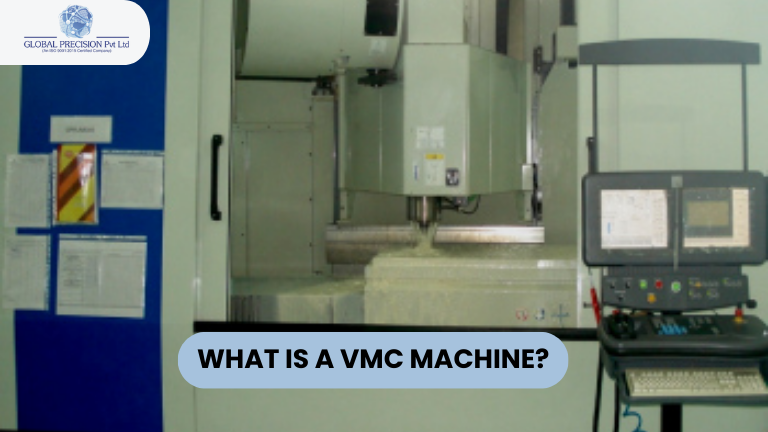
A Vertical Machining Center (VMC) is a CNC Machining tool that machines with a vertical spindle. The VMC machines have been the backbone of most shops today, and these machines are capable of drilling, milling, and boring with great accuracy.
The “Axis” of a VMC machine refers to the direction in which the workpiece or tool can move. The more axes a machine has, the more complicated a part it can make.
3-Axis VMC – The Industry Standard
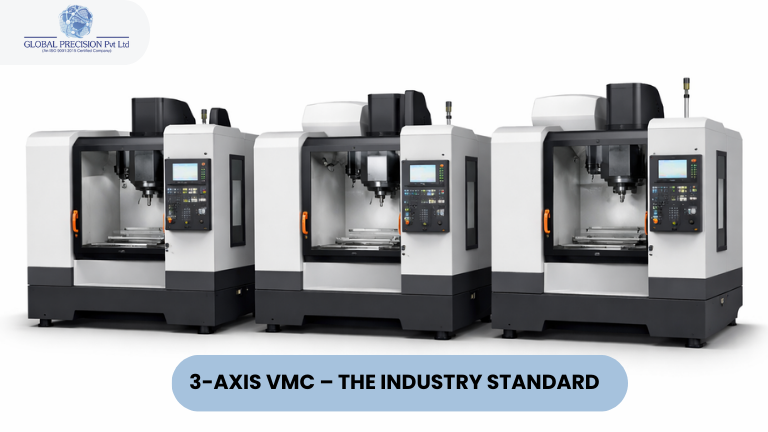
The 3-axis machine is a common type of milling. In 3-axis machining, a tool moves along three different straight paths –
- X-Axis – Left to Right
- Y-Axis – Front to Back
- Z-Axis – Up to Down
When to Use a 3-Axis VMC
- Easy Parts – The 3-Axis VMC is perfect for making a single side of flat parts (like plates or brackets). You only need to run the machine and only work on one side of the part at a time.
- Cost – 3-Axis machines are available for less money to buy and with lesser ongoing costs.
- User Friendly – 3-Axis machines require less programming complexity and less technical training to use.
Limitation
If the part being made requires machining on the side or bottom, it will require stopping and moving the part manually. Doing this takes considerable time and can result in small errors.
4th Axis VMC Machining – The Productivity Booster
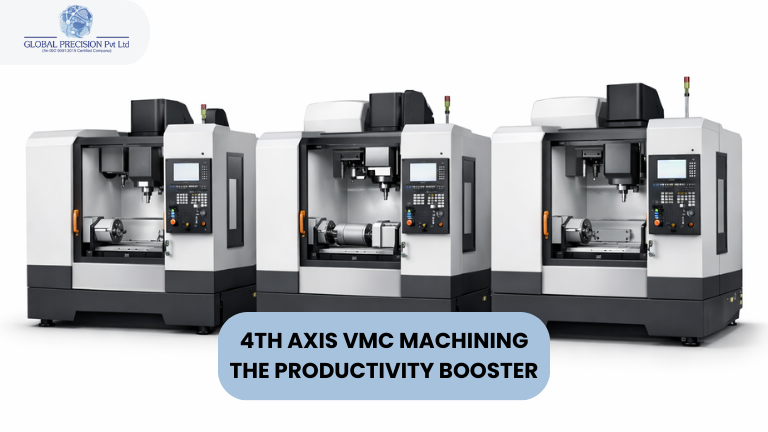
4th Axis VMC Machining capabilities bring rotational motion to the standard three axes (X, Y, and Z). This is often referred to as the “A-axis,” allowing parts to rotate around the X-axis.
4th Axis VMC Machining Benefits
- Multi-directional Access – The 4th Axis VMC machining process allows for machining all four sides of the part without having to remove or reposition the part; it simply rotates to the next side for servicing.
- Ability to Create Complex Geometries – The 4th Axis VMC is ideal for creating complex geometries, such as many gears, camshafts, or mechanically drilled holes at various angles.
- Less Time to Change Setups – Due to the reduced need to manually flip parts for machining, the operator saves hours of his/her time from the setup process and also can minimize the potential for human error.
Examples of Components Produced Using 4th Axis VMC Machining –Some examples of parts produced with 4th Axis VMC Machining Components with curved engravings and cylindrical form, as well as parts that require multiple accurately placed holes that travel around the curvature of the component, like a “friction ring” component used in piston engines.
5-Axis VMC Machine – The Peak of Precision
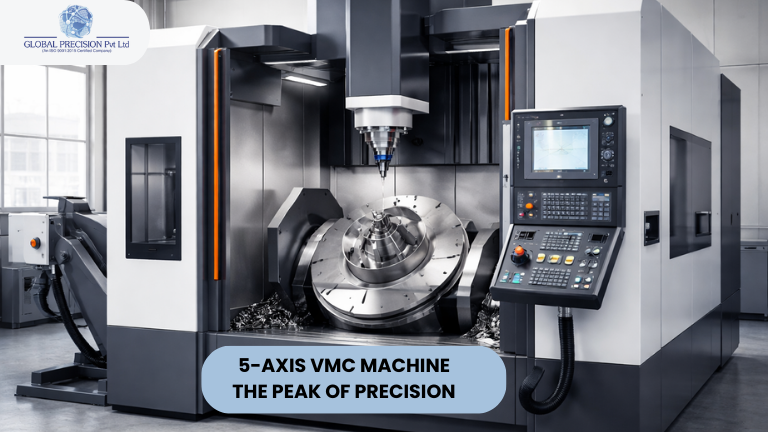
5-Axis VMC Machines provide the best option for advanced technology and manufacturing. These machines allow for movement along the three linear axes: X, Y, and Z, as well as two rotational axes (often A & B, or B & C). Because of this, you can access almost any part of your machining part from almost any angle.
Why Would You Use a 5-Axis Machine?
1. Extreme Complexity – If you require high precision and accuracy to create complexly-shaped products, such as turbine blades, propellers, or orthopedic implants, a 5-axis machine is the only choice.
2. Single Setup – You can manufacture five of the six sides of your part in one machine setup. This means that any holes and/or surfaces will perfectly align with each other.
3. Better Surface Finish – With the ability to tilt the tool, you are able to hold the cutting edge at its optimum position relative to the material, resulting in a smoother surface finish.
4. Shorter Tools – By tilting the part, you can get the tool closer to the workpiece, allowing you to use shorter, stiffer tools that don’t vibrate as much.
Comparative Table – Which One Do You Need?
| Feature | 3-Axis VMC | 4-Axis VMC | 5-Axis VMC |
| Movement | X, Y, Z | X, Y, Z + Rotation (A) | X, Y, Z + 2 Rotations (A, B) |
| Setup | Multiple manual setups | Usually 1-2 setups | Mostly single setup |
| Best For | Flat, simple parts | Cylindrical/Angular parts | Complex, curved surfaces |
| Cost | Lowest | Moderate | Highest |
| Programming | Simple | Intermediate | Advanced/Complex |
Which One Is Best for Your Precision Parts?
Selecting the suitable machine depends on three main elements –
1. Part Complexity
If the piece you require is a simple bracket pierced with holes at the top, utilizing a 3-axis machine will be the cheapest option. If, conversely, you are making aerospace or medical components with “undercut” or complex angled features, you will need a 5-Axis Vertical Machining Centre virtually every time.
2. Production Numbers
If your manufacturing involves 1,000 pieces of the same component with features on 4 sides, the time savings that can be achieved by eliminating the need to turn 1,000 parts manually will quickly make purchasing a 4th Axis VMC Machining worthwhile.
3. Costing vs. Precision
Although 5-axis machining provides the ultimate in terms of accuracy, it does carry a high price tag; therefore, a well-run shop such as Global Precision Pvt Ltd utilizes a combination of all three to achieve cost and capability balance. Most components requiring high accuracy can be manufactured more economically on a 4-axis machine.
Conclusion
CNC Machining does not have a “one size fits all” approach. For basic machining types, the 3rd axis machines provide a reliable option. However, for parts that require machining on multiple sides or creating parts with curved surfaces (the work can take place on the machine bed or a fixture plate), 4th axis VMC machining is often the preferred choice. Finally, if an extremely high level of accuracy is required and/or the shape is particularly difficult to produce due to its complexity, 5th-axis machining becomes the best option.
Selecting the right type of CNC machine for producing a part of a given complexity will provide you with the best quality at the least cost.
Also Read: CNC Milling vs CNC Turning – Key Differences Explained